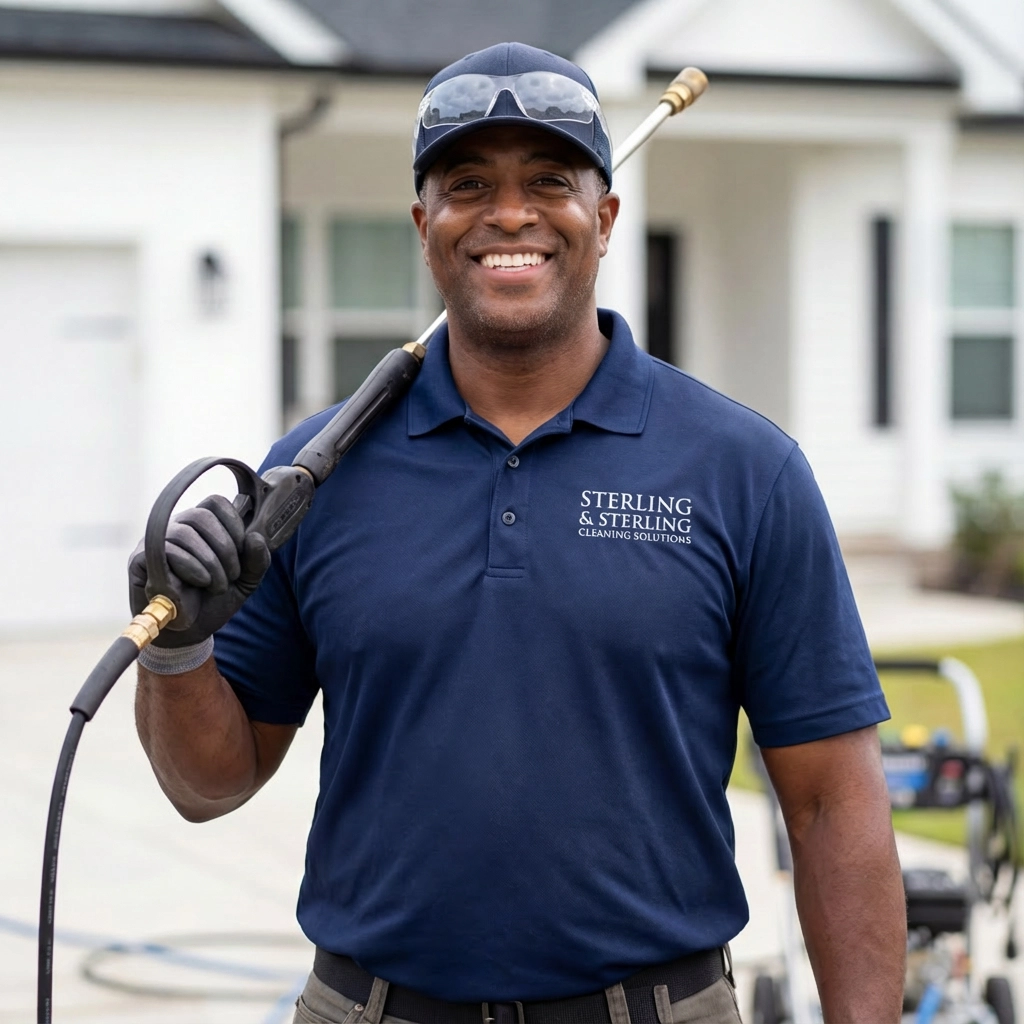
If you are comparing quotes and one company says "pressure washing" while another says "soft washing," those are not two words for the same job. They are different processes, and on a shingle roof only one of them is acceptable.
Here is what separates them, and how to work out which your property needs.
The one-line version
Pressure washing removes material with water force. Soft washing removes it with cleaning solution at low pressure.
Everything else follows from that.
What pressure washing is for
Pressure washing uses high-pressure water to physically remove material from a surface. It is fast, effective, and on the right surface it is exactly what you want.
Good candidates:
- Concrete driveways, sidewalks, and patios
- Brick and stone flatwork
- Masonry retaining walls in sound condition
- Garage aprons and pool decking
The common thread is hardness. These surfaces are dense enough that water force removes the dirt without removing any of the surface itself.
What soft washing is for
Soft washing applies a cleaning solution, lets it dwell long enough to kill the organic growth, then rinses at low pressure.
Good candidates:
- Asphalt shingle, tile, and metal roofing
- Painted siding of any kind
- Stucco and EIFS systems
- Older wood: fences, decks, cedar siding
- Screen enclosures and pool cages
- Historic brick with soft mortar
The common thread here is that the surface would be damaged by force but still needs cleaning.
Why a shingle roof must be soft washed
This is the part worth being blunt about.
Asphalt shingles are protected by a layer of ceramic-coated granules embedded in the surface. Those granules shield the asphalt mat underneath from UV, and they are a large part of what determines how long the roof lasts.
High-pressure water dislodges them. You can often see the evidence afterward as granule accumulation in the gutters. Once they are gone they do not come back, and the mat underneath is exposed.
Two consequences follow:
- You have shortened the life of the roof in exchange for one afternoon of looking clean.
- You may have created a warranty problem. Shingle warranties commonly exclude damage caused by improper cleaning. Terms vary by manufacturer, so check yours, but pressure damage is not usually something a warranty will absorb.
This is not one contractor's opinion. Shingle manufacturers and the roofing industry consistently point to low-pressure cleaning for asphalt roofs. The Asphalt Roofing Manufacturers Association publishes guidance on algae and roof maintenance, and your specific shingle manufacturer will have care instructions worth reading before anyone touches the roof.
What the black streaks actually are
Worth understanding, because it explains why chemistry works and force does not.
The dark streaking common on Gulf Coast roofs is caused by Gloeocapsa magma, a type of cyanobacteria. It feeds on components used in asphalt shingles, which is why it colonises roofs specifically rather than growing evenly on everything.
It is a living organism attached to the shingle surface. Removing the visible layer does not kill it, which is exactly why pressure-washed roofs tend to streak again sooner than owners expect. A proper soft wash targets the organism itself, which is why the result holds up better.
This is also why "my last guy did it and it came back really fast" is such a common complaint. It came back because it was never actually killed.
How long does each last?
Longer for soft washing, and I am not going to give you a number, because it varies enormously with shade, moisture, tree cover, and how close you are to the water. A fully shaded roof in Friendswood and an open sunny roof in Fulshear will not behave the same way.
What I can say is that soft washing addresses the organism rather than the symptom, so the interval before regrowth is visible is meaningfully longer. Soft washing is not the gentler-but-weaker option. It is the more thorough option that also happens to be gentler.
The reason it takes longer on the day is dwell time. The solution has to stay on the surface long enough to work, and that is the step careless operators skip.
What about siding and fences?
Same logic, different surfaces.
Painted siding should be soft washed. High pressure strips aged paint and can force water behind the siding into the wall assembly, which causes problems you will not discover for a while.
Stucco and EIFS must be soft washed. These systems are specifically vulnerable to water intrusion, and pressure washing them is an expensive mistake.
Wood fences and decks should be soft washed or cleaned at genuinely low pressure. Wood has softer growth between the harder grain lines, and pressure tears it out, leaving a furred surface that holds more dirt and moisture than before. So it looks worse, faster.
Brick and concrete flatwork takes pressure fine, with one exception: historic masonry with soft lime mortar. High pressure blows mortar out of the joints, and repointing is not a cheap afternoon.
How to tell if a contractor knows the difference
A few things worth listening for when you are getting quotes.
- They ask what surfaces are involved before quoting. Someone who gives a flat price over the phone without knowing whether it is stucco or brick is not adjusting their method.
- They mention dwell time. If nobody says anything about letting solution work, they are planning to spray and rinse, which is not soft washing.
- They talk about protecting landscaping. Pre-rinsing beds is standard on any soft wash. Its absence tells you something.
- They say no to something. A contractor who will pressure wash anything you point at is telling you they use one approach for everything.
Most properties need both
That is the practical takeaway. A typical house needs pressure washing on the driveway and walkways, and soft washing on the roof, siding, and fence. Same visit, different methods, different pressures.
The skill is not owning the machine. It is knowing which surface gets which treatment, and being willing to spend the extra time on the ones that need it.
Get a straight answer about your roof
If you have streaking and you are not sure whether you are looking at cleaning or replacement, I will tell you honestly. Sometimes a roof genuinely is at the end of its life and washing it is throwing money away, and I would rather say so than take the job.
Free quotes across League City, Katy, and the Greater Houston area. Call or text (404) 324-9177.
Share this article